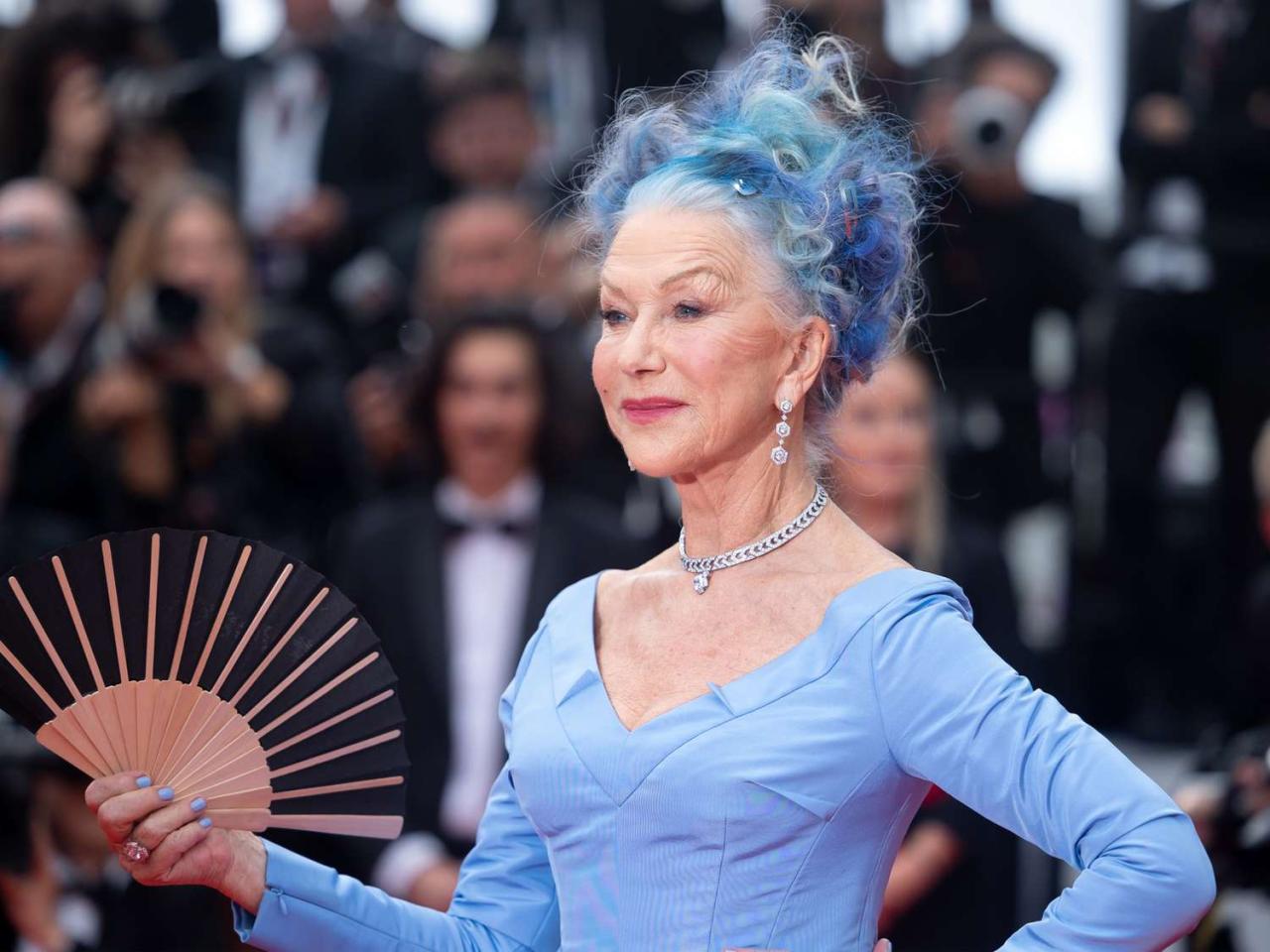
Helen Mirren always completely nails the assignment, whether she's embracing a geek-chic look for a premiere or revealing herself as a true sneaker enthusiast. So it should surprise absolutely no one that for the screening of the film Jeanne du Barry at the 76th Cannes Film Festival, she appeared with a striking blue hairdo – perfectly matching her period-appropriate outfit of the same colour, complete with a fan.
For those who didn't read many books about Marie Antoinette in high school, Jeanne du Barry, aka Comtesse du Barry, was a famous courtesan who climbed the ranks of King Louis XV's court, wielding disproportionate influence over the king and momentarily serving as his mistress. (Naturally, Marie Antoinette was not a fan).
A bold choice that paid off
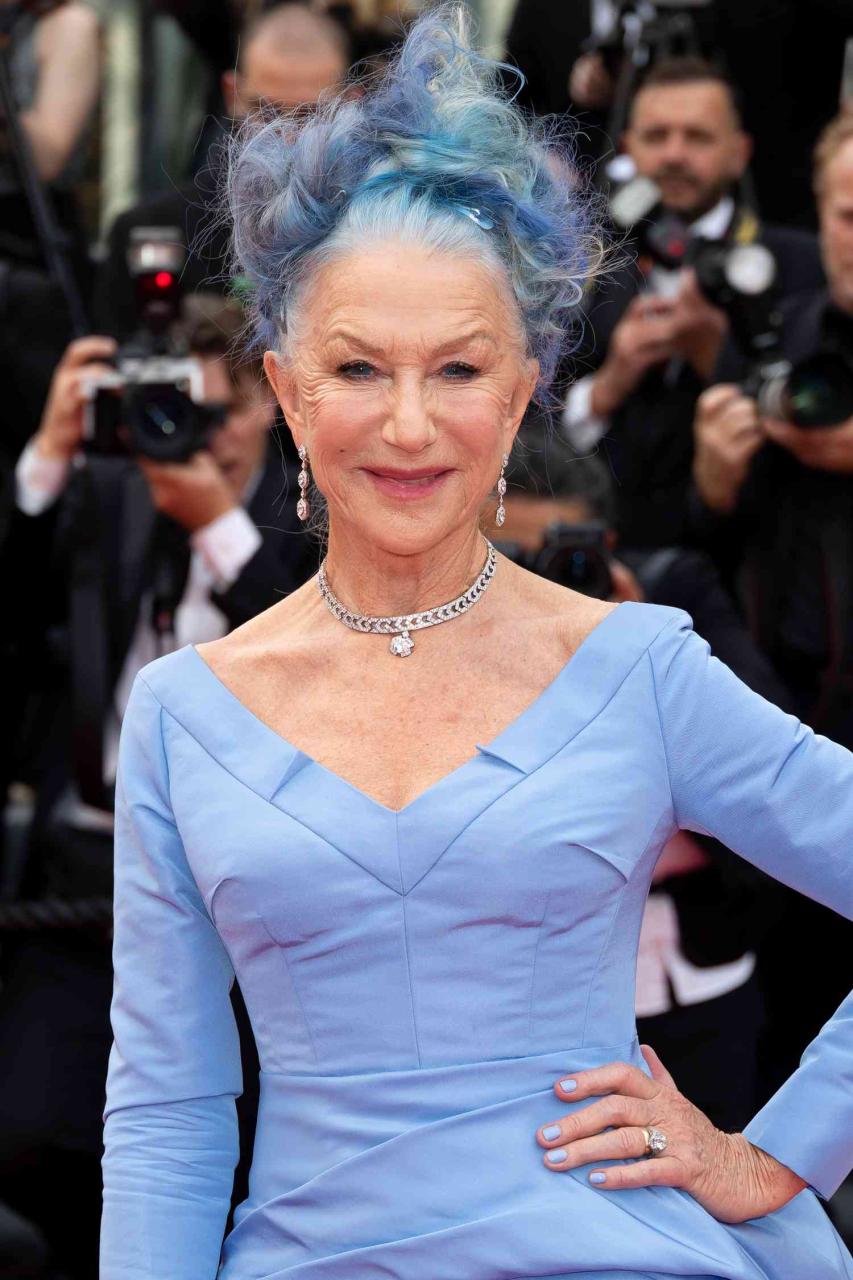
The blue shade, courtesy of colourist Halley Brisken, was no whim. It sits within the broader trend of statement hair colour that has dominated red carpets in recent seasons. But where the trend often defaults to pastels or understated tones, Mirren committed to a saturated, almost neon blue that left no one indifferent.
The style itself — a structured bouffant — recalls the powdered wigs of the eighteenth-century French aristocracy. This was no accident: the film Jeanne du Barry tells the story of a commoner's rise to become a royal favourite, and Mirren, who plays Louis XV in the film, visually pays homage to the era.
Why blue hair works
Blue has become one of the most popular statement hair colours over the past few years, partly thanks to celebrities like Lady Gaga, Katy Perry, and Zendaya, who have all experimented with various shades. The colour works on a spectrum: from icy pastels that read as silver in certain lights, to deep navy that looks almost black, to the bright aqua and electric blue that Mirren chose.
For those not willing to commit to a full head of blue, there are softer entry points. Blue peekaboo highlights under brunette hair reveal themselves only in movement or under bright lights. Blue-tipped ends, popularised by the ombré trend of the early 2010s, are still a valid option. Temporary blue chalks or colour-depositing conditioners let you test the shade for a week or two without committing.
For those ready to go all in, the maintenance is more manageable than you might think. Blue fades faster than warmer colours, but regular touch-ups every four to six weeks keep the shade vibrant. Colour-depositing conditioners like Overtone's blue range can extend the time between salon visits.
Mirren's long history of bold choices
At 78, Helen Mirren has built a reputation for fashion and beauty choices that defy age expectations. She has worn sheer gowns on red carpets, sported vividly coloured wigs, and spoken openly about plastic surgery (declaring herself a fan of Botox, much to the tabloid press's delight). Her blue hair moment is part of this longer pattern: a refusal to be pigeonholed by what older women are "supposed" to wear.
This isn't vanity — it's a kind of permission. Mirren's visibility at one of the world's most-watched film festivals, wearing a colour most stylists would warn a client away from at any age, sends a message that style has no expiry date. The reaction on social media was overwhelmingly positive: thousands of users, particularly women over 50, posted their own blue-haired selfies in solidarity.
The historical context of hair colour as rebellion
Brightly coloured hair has long been a form of self-expression that signals independence from conventional beauty standards. In the 1960s and 70s, punks adopted unnatural colours as part of a broader rejection of mainstream culture. In the 1980s, glam rock pushed neon shades into the mainstream. In the 2010s, the "ombre" and "balayage" trends made coloured hair acceptable in professional settings.
Today, bright colour sits in an interesting place: it's no longer shocking, but it still requires a certain confidence. Mirren's blue is a reminder that ageing doesn't have to mean retreating into neutral palettes. In fact, the freedom that comes with not caring what others think can make older women even better candidates for bold colour — there's less career risk, less social pressure, and more life experience to draw confidence from.
How to recreate the look
For those inspired by Mirren's Cannes moment, several approaches work:
Full colour commitment
The most striking option is a full head of bright blue. This requires bleaching the hair first (which damages it to some degree), then applying a blue toner or semi-permanent colour. For those with darker natural hair, this may take two or three bleaching sessions to reach a pale enough base. The cost varies widely depending on the salon and the starting point, but expect £200–£500 for the initial colour, plus maintenance every four to six weeks.
Blue highlights or peekaboo
A more conservative approach is to add blue highlights throughout the hair, or to colour the underneath sections in blue while leaving the top layers a more natural shade. This way, the blue reveals itself only when the hair moves or when it's styled in a particular way. This is also a good option for those who need to maintain a professional appearance in their day-to-day life.
Wigs and extensions
For those who want the look without the commitment, wigs and extensions are increasingly high-quality. A lace-front wig can look completely natural, and can be removed at the end of the day. Clip-in extensions in blue are also available, though they show their true nature when removed.
Temporary options
Colour-depositing conditioners, coloured hair mascaras, and hair chalks all provide temporary colour that washes out in one to several shampoos. These are excellent for testing the waters, or for special occasions where you want to make a statement without long-term commitment.
We'll take it as a sign to be a bit bolder with hair colour this summer – and as a reason to consider full-on cosplay once the film hits theatres.